
Here is a brief description of some of the most common materials and assemblies used for 120/240 volt electrical wiring in the United States.
RIGID PIPE
There are several different types of rigid pipe for electrical wiring. Collectively they’re usually referred to as conduit.
Electrical Metallic Tubing
For ordinary wiring throughout a building electrical metallic tubing (EMT) is typically used. EMT is a thin-walled tubing (it’s sometimes called “thinwall”) that’s usually made from steel. It can be easily bent in the field using a conduit bender. There are no threads on EMT, so couplings and connectors are attached with a set screw fitting for dry locations (pretty much anything inside the building) or with a raintight compression fitting for wet locations. EMT is installed and connected to panels and junction boxes and then separate insulated wires are pulled through it.

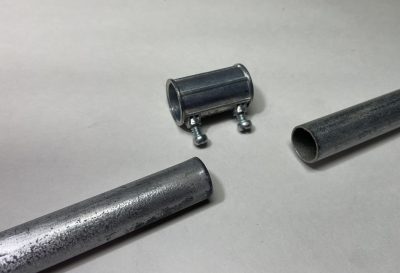
EMT is required in the city of Chicago and many of the surrounding suburbs for all electrical circuits that run through a house or commercial building. It’s also very common throughout the USA for interior wiring in commercial buildings.
EMT pipe can be the ground wire in a circuit, or it can have a separate ground wire pulled through it.
Rigid Metal Conduit (RMC) and Intermediate Metal Conduit (IMC)
RMC and IMC are usually made from steel, and they have threads and use threaded connections. Their primary use in residential construction is for the service riser – the pipe that the electrical service wires from the utility go into. They’re also used where mechanical protection is needed and for running larger wires, like the large feeder wires running from the main electrical panel to a subpanel.
Just as with EMT, these conduits are installed and fastened and then wire is pulled through.
PVC Conduit
PVC conduit is the most common material used for underground wiring, though it can be exposed. It comes in two thicknesses – schedule 40 and schedule 80. The thicker schedule 80 is generally required where physical protection is needed.
PVC expands and contracts quite a bit with changes in temperature, so expansion fittings might be required to prevent heat-related distortion of the conduit.
As with the other rigid pipes, PVC conduit is installed and then wires are pulled through.
FLEXIBLE CABLE
Nonmetallic Sheathed Cable
The most common type of flexible electrical cable is called nonmetallic sheathed cable (NM cable). It’s been the most common type of residential wiring since the 1950’s and it has a very long history of successful usage. It’s often referred to as “Romex©”, but that’s a trade name. Not all NM cable is Romex©.
In Chicago and many of the surrounding suburbs NM cable isn’t allowed. In these cities all wiring must be installed in rigid metal pipe, typically EMT throughout the house and RMC or IMC for the service riser.
NM cable contains 2 or more insulated wires along with a bare ground wire, all contained within an outer plastic sheathing. Usually there’s paper wrapping all of the wires, and sometimes the paper only wraps the ground wire. It’s typically labelled as something like 14/2 or 12/3. The first number is the size of the conductor as described by its American Wire Gauge (AWG) designation (the smaller the number the bigger the wire), and the second number is the number of current-carrying conductors. So 14/2 is 14 AWG wire with 2 current-carrying conductors (1 hot and 1 neutral) plus a ground wire. And 12/3 is 12 AWG wire with 3 current-carrying conductors (2 hots and 1 neutral – see my article on “multi-wire branch circuits” to understand why this might be helpful) plus a ground wire.
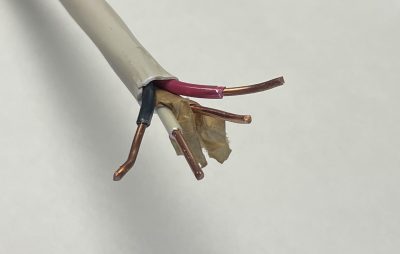
Since about 2000 or so the color of the outer sheathing identifies the wire gauge. White is 14 AWG, yellow is 12 AWG, orange is 10 AWG, and black is larger. But keep in mind that older NM cable might not use this color coding.
There are different types of NM cable, designated by a letter after the NM. These have some special characteristics, for example they’re good for a higher temperature rating, or for wet or damp locations.
NM cable should be run to closely follow the surfaces of the building and protected from physical damage “where necessary”. Where this protection is necessary could fill many pages, and it even will vary from place to place. NM cable should never be strung through the air to attach to some electrical equipment. This is (incorrectly) done sometimes to run power to a water heater or furnace or garbage disposer. NM cable should never be used with a plug because it’s not intended to move back and forth many times. It’s intended to be secured in place and left there.
Armored Cable
Armored cable, or armor-clad cable, is known as AC cable. It consists of insulated wires wrapped in Kraft paper wrapped by a flexible spiral metal sheath. This outer metal sheath works as the ground wire. AC cable was the very first cable system listed in the National Electrical Code so it has a long history of successful usage and used to be very popular. It’s often referred to as BX cable.
The cut ends of AC cable are very sharp and can slice through wire insulation, so connectors must include a little red plastic bushing, often called a redhead, that covers and protects the cut end of the cable.
AC cable also includes an internal bonding strip – a small silver-looking wire that remains in contact with the outer sheathing. This bonding strip is not part of the ground wire, and it shouldn’t be brought into any junction box.
AC cable comes as an assembly – the wires are run through the outer sheathing at the factory. You have to be careful when you cut the outer sheathing to length so that you don’t accidentally cut the wires inside.
Metal-Clad Cable
Metal-clad cable, or MC cable, is very similar to AC cable. But the insulated conductors are wrapped in a thin plastic and then the flexible metal sheathing, which might be steel or aluminum. MC cable always uses a separate ground wire – the outer metal sheathing is never allowed as the ground wire. Fittings that are listed for use with MC cable protect the cut ends of the cable, so the redhead bushings aren’t required with MC cable like they are with AC cable.
MC cable also comes as an assembly, with the wires already run through the outer sheathing.
Flexible Metal Conduit
Flexible Metal Conduit, or FMC, is an empty steel or aluminum outer sheathing. The wires, including a ground wire, are then pulled through it. In some cases, when the FMC run is no more than 6 feet, it can be used as the ground wire as long as the proper fittings are used. FMC is often called Greenfield, which is the name of its inventor.
FMC is commonly used to connect appliances like furnaces and electric water heaters. It may not be used in wet locations.
Liquidtight Flexible Metal Conduit
Liquidtight FMC is basically the same thing as FMC except it has an outer coating of PVC that prevents water from getting into it. It’s very commonly used outside to connect air conditioner condensing units to their disconnect switches. A separate ground wire must be pulled through along with the current-carrying conductors.
Underground Feeder Cable
Underground Feeder, or UF cable, is very similar to standard NM cable, except that the outer sheathing is solid and there’s no paper inside. Also, NM cable has only one cavity that all of the wires run through, while UF cable has each individual wire captured within its own cavity in the cable.

UF cable is rated for direct burial underground, which of course makes it very common to use for running power to garages or sheds or exterior lights. It’s also rated for above-ground wet locations. Just like with NM cable it needs to be protected from physical damage. So where UF cable emerges from (or goes into) the soil it must be protected up to a height of 8 feet. This protection is usually provided by schedule 80 PVC.
This kind of cable is almost always clearly identified with the “UF” designation on the cable.
More Posts You May Find Interesting
Kitchen island receptacle outlets
The rules for receptacle outlets at kitchen islands have changed quite a bit over the last few code cycles. Here’s a summary of these rule changes. Our story begins way back in the last century
I Recommend that you read this
I’ve read a lot of inspection reports over the years from other inspectors, and mostly they’re terrible. Not necessarily the technical content (although that can be pretty bad too), but in the way they’re written.
Is this to code?
A home inspection isn’t supposed to be a code inspection, but a very common question from buyers after I’ve pointed out a problem is something like, “Is this a code violation?” I’m happy to talk
Occupancy Classifications
Occupancy classification is the formal designation of the primary purpose of the building, structure or portion thereof. These are the occupancy classifications as taken from the International Fire Code 2024. Many of these occupancies have
Fire Extinguishers
According to the International Fire Code and the National Fire Protection Association Fire Code (NFPA 1) portable fire extinguishers are required in new and existing buildings with these occupancy types: A, B, E, F, H,
Wire colors
The color for wire insulation is clearly described in the National Electrical Code and is an important part of the electrical installation. The colors of the wire insulation help to identify the purpose and usage
