
According to the International Fire Code and the National Fire Protection Association Fire Code (NFPA 1) portable fire extinguishers are required in new and existing buildings with these occupancy types: A, B, E, F, H, I, M, R-1, R-2, R-4, and S.
That, my friends, is every occupancy type there is except for R-3, which is one- and two-family dwellings. (And also occupancy type U, which is miscellaneous.)
So portable fire extinguishers are required by all the codes, covering pretty much every square inch of the United States, in pretty much every building, new and old, except single family homes and duplexes. And let’s face it, you should have a fire extinguisher in your single family home, too. Especially near the kitchen.
Here’s some basic information on fire extinguishers that will help you stay safe.
The most important thing to understand about portable fire extinguishers is that they need to be serviced at least once a year by a person who’s licensed or certified in the local jurisdiction. A new date tag is installed when the service is performed which will have the year printed on it and the month of service is hole-punched into the tag. The color of the tag will vary by year. In Illinois, the colors rotate through blue, white, yellow, and green. Tags in 2025 are yellow and 2026 will be green. So if you live in a multi-unit building it’s easy to know when the fire extinguishers are serviced because the color of the tag will change.
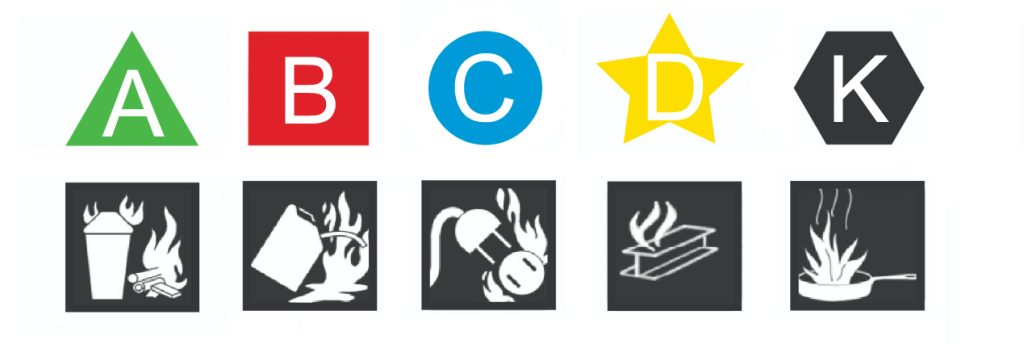
Portable fire extinguishers are rated by the type of fire that they’re designed to extinguish. There are five classifications of fires:
Class A fires are in ordinary combustible materials like wood, cloth, paper, rubber, and many plastics.
Class B fires are in flammable liquids, combustible liquids, and flammable gases. **
Class C fires involve energized electrical equipment.
Class D fires are in combustible metals such as magnesium, titanium, etc.
Class K fires are in cooking appliances that involve combustible cooking media (vegetable or animal oils and fats).
In addition to these letter classifications, Class A and Class B fire extinguishers have a numerical rating that describes the size of the fire that can be expected to be extinguished when used by an untrained operator. Class A ratings range from 1 to 40, while Class B ratings range from 1 to 640.
Many portable fire extinguishers are rated for Class A, Class B, and also Class C fires. These extinguishers are labelled as ABC, although there will be numbers in front of the A and B. There should also be a pictogram on every fire extinguisher that describes its rating.
Where to install fire extinguishers
The general requirement for portable fire extinguisher placement for a Class A fire hazard is for a minimum 2-A extinguisher for low and moderate hazard occupancies, and a minimum 4-A extinguisher for high hazard occupancies. In all cases the maximum distance of travel to an extinguisher is 75 feet.
For Class B fire hazards the basic minimum extinguisher rating ranges from 5-B with a maximum distance of travel to an extinguisher of 30 feet (for low hazards), up to an 80-B with 50 feet of maximum distance (for high hazards).
Portable fire extinguishers for Class C hazards are selected on the basis of the anticipated Class A or B hazard.
Portable fire extinguishers for Class D hazards have their own special rules, and if you’re burning magnesium then you should already know where to look for those rules. (Magnesium will burn underwater. Don’t mess with magnesium.)
Every restaurant kitchen with a deep fat fryer is required to have a Class K fire extinguisher. Class K fire extinguishers are silver, whereas pretty much all others are red.
How to install fire extinguishers
Portable fire extinguishers must be installed in conspicuous locations where they will be readily accessible and be immediately available for use. These locations should be along normal paths of travel. Don’t store anything in front of a fire extinguisher. Don’t block a fire extinguisher. If they’re in a room where visual obstruction can’t be avoided then there should be signs that are readily visible pointing to the fire extinguishers.
Portable fire extinguishers must be hung from a bracket attached to the wall, or in a cabinet on the wall. They can’t just be sitting on the floor or on a shelf or table. If a fire extinguisher is in a cabinet then that cabinet can’t be locked, although there are some exceptions if it might be subject to malicious use or damage.
Maintenance of fire extinguishers
To repeat from above, portable fire extinguishers need to be serviced at least once a year by a person who’s licensed or certified in the local jurisdiction. A new date tag is installed when the service is performed which will have the year printed on it and the month of service is hole-punched into the tag. The color of the tag will vary by year. In Illinois, the colors rotate through blue, white, yellow, and green. Tags in 2025 are yellow and 2026 will be green. So if you live in a multi-unit building it’s easy to know when the fire extinguishers are serviced because the color of the tag will change.

This yearly service is a basic external visual examination to detect obvious problems. It doesn’t involve discharging the fire extinguisher or testing it under use.
Portable fire extinguishers are also supposed to be inspected at least once a month. This is usually done (when it’s done at all, which is seldom) by building maintenance personnel. It’s just a quick check that the fire extinguisher is still where it’s supposed to be, that it’s visible and accessible, and that it looks to be in good condition. Many places will have their maintenance person initial the date tag when they do their monthly check.
These are just some of the basics of portable fire extinguishers. The important things to remember are that portable fire extinguishers are required in pretty much every building except single family homes, and they need to be serviced by a certified professional every year.
Stay safe out there.
Are you curious about the difference between flammable liquids and combustible liquids? The International Fire Code has these definitions:
Combustible liquid – A liquid having a closed cup flash point at or above 100 °F.
Flammable liquid – A liquid having a closed cup flash point below 100 °F.
Flash point – The minimum temperature in degrees Fahrenheit at which a liquid will give off sufficient vapors to form an ignitable mixture with air near the surface of in the container, but will not sustain combustion.
More Posts You May Find Interesting
Kitchen island receptacle outlets
The rules for receptacle outlets at kitchen islands have changed quite a bit over the last few code cycles. Here’s a summary of these rule changes. Our story begins way back in the last century
I Recommend that you read this
I’ve read a lot of inspection reports over the years from other inspectors, and mostly they’re terrible. Not necessarily the technical content (although that can be pretty bad too), but in the way they’re written.
Is this to code?
A home inspection isn’t supposed to be a code inspection, but a very common question from buyers after I’ve pointed out a problem is something like, “Is this a code violation?” I’m happy to talk
Occupancy Classifications
Occupancy classification is the formal designation of the primary purpose of the building, structure or portion thereof. These are the occupancy classifications as taken from the International Fire Code 2024. Many of these occupancies have
Fire Extinguishers
According to the International Fire Code and the National Fire Protection Association Fire Code (NFPA 1) portable fire extinguishers are required in new and existing buildings with these occupancy types: A, B, E, F, H,
Wire colors
The color for wire insulation is clearly described in the National Electrical Code and is an important part of the electrical installation. The colors of the wire insulation help to identify the purpose and usage
