
In the Chicagoland area, and in Chicago especially, there are some pockets of problem sewers – areas where the city sewer is prone to be overwhelmed by heavy rains and back up into basements. Of course this can cause a lot of damage, and it’s a health hazard as well.
Most cities in Chicagoland have done a lot of work over the last several decades to reduce the problem, but it still happens.
The origin of the problem really lies in the fact that many of the older cities and suburbs have combined storm and sanitary sewers, so all of the rain water is collected in the same pipe as the poop water. Newer cities separate these two drain systems.
There are several different ways to attack this sewer backup problem, and one way is to install a flood control system in the front yard (or the yard leading to whichever way the sewer runs). Here are the basic components of such a system.
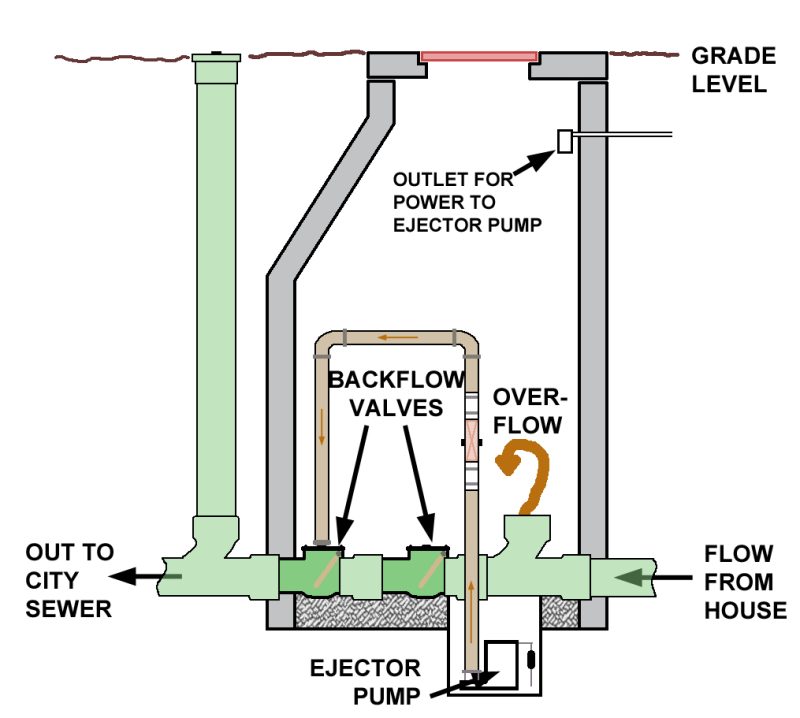
There’s a large pit dug into the ground and lined with concrete, or sometimes it’s made from concrete blocks. At the bottom of the pit runs the sewer line from the house out to the city sewer in the street. And placed into this sewer line is a backflow valve. The basic arrangement is that this backflow valve has a flap that can only open in one direction – the direction of sewage leaving the house and going out to the street. So under normal conditions sewage from the house flows out to the street. Often there are two valves built into the system.
But if there’s a heavy rain and the sewer gets overwhelmed, and if that sewage then wants to flow from the city sewer back into the house, then that valve will close automatically and prevent sewage from entering the house. Problem solved – almost.
When this happens the home’s residents wouldn’t be able to use any water, because there’s nowhere for it to go – the valve is closed and blocked. But instead, an overflow opening is installed and the drain sewage from the house would come out of this overflow spot and into the pit, where it would flow into another smaller pit with an ejector pump. An ejector pump is quite powerful and it can grind up the solid waste that might be present in the sewage. The pump then pumps this overflow sewage up and over, past the backflow valve, and into the city’s sewer drain. This allows the residents to continue using all of their plumbing fixtures.
Keep in mind that this system is for sewage only – the drain water from your sinks and tubs and showers and from your toilets. It’s not for groundwater. Even with this type of flood control system it’s possible for the ground to become saturated from rain, and that water can still find its way through the foundation wall or up through the floor slab and into your basement. Solving the problem of groundwater is another issue.
More Posts You May Find Interesting
Kitchen island receptacle outlets
The rules for receptacle outlets at kitchen islands have changed quite a bit over the last few code cycles. Here’s a summary of these rule changes. Our story begins way back in the last century
I Recommend that you read this
I’ve read a lot of inspection reports over the years from other inspectors, and mostly they’re terrible. Not necessarily the technical content (although that can be pretty bad too), but in the way they’re written.
Is this to code?
A home inspection isn’t supposed to be a code inspection, but a very common question from buyers after I’ve pointed out a problem is something like, “Is this a code violation?” I’m happy to talk
Occupancy Classifications
Occupancy classification is the formal designation of the primary purpose of the building, structure or portion thereof. These are the occupancy classifications as taken from the International Fire Code 2024. Many of these occupancies have
Fire Extinguishers
According to the International Fire Code and the National Fire Protection Association Fire Code (NFPA 1) portable fire extinguishers are required in new and existing buildings with these occupancy types: A, B, E, F, H,
Wire colors
The color for wire insulation is clearly described in the National Electrical Code and is an important part of the electrical installation. The colors of the wire insulation help to identify the purpose and usage
