
The rules for receptacle outlets at kitchen islands have changed quite a bit over the last few code cycles. Here’s a summary of these rule changes.
Our story begins way back in the last century – 1990 to be exact. This is the first year that the National Electrical Code (NEC) had requirements for receptacle outlets at kitchen islands and peninsulas. In that edition section 210.52(C) stated: “Island and peninsula counter tops 12 inches or wider shall have at least one receptacle for each four feet of counter top.”
Over the years there were many changes and refinements, until we got to a fairly stable situation.
For kitchen island countertops there had to be at least one receptacle outlet serving the countertop if the island was bigger than 24 inches by 12 inches. The required receptacle had to be on or above the countertop – but not more than 20 inches above. But there was an EXCEPTION: if the countertop was flat with no backsplash and there was no means to mount a receptacle within 20 inches above the countertop then the required receptacle could be below the countertop, but not more than 12 inches below.
To summarize, there had to be a receptacle outlet serving the kitchen island countertop and it was supposed to be on or above the countertop. But an EXCEPTION allowed the receptacle to be just slightly below. So in practice, the required receptacle was almost always installed on the side of the cabinet just below the countertop. It looked like this very typical kitchen island.
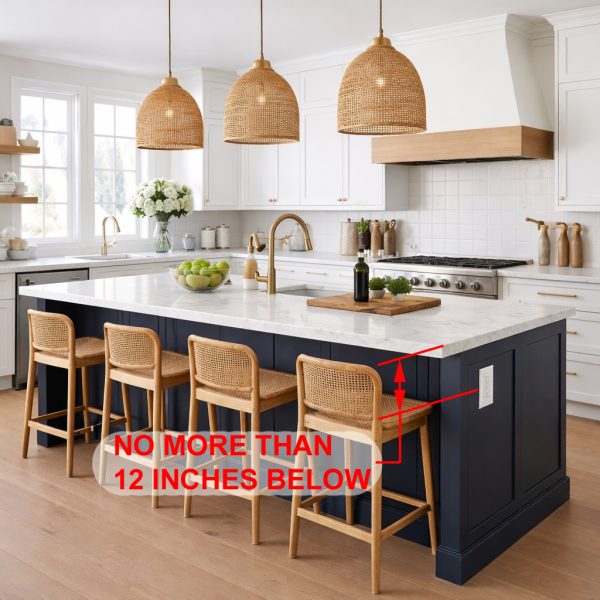
The same basic rule applied to kitchen countertop peninsula areas too. There had to be one receptacle outlet, but there never had to be more than one. And this rule remained for a long time.
Then in the 2020 edition things changed a little bit. Previously a receptacle was required only if the island was bigger than 2 feet by 4 feet. But that rule was changed, so that now at least one receptacle outlet was required at every island regardless of its size. For the first 9 square feet of island countertop space one receptacle was required, and then one for each additional 18 square feet or fraction thereof. So if the island countertop space was 14 square feet there had to be at least two receptacles serving that countertop (one for the first 9 square feet and one for the additional 5 square feet).
These receptacles could still be mounted below the countertop surface, but no more than 12 inches below.
Then in the 2023 edition there was a fairly major change. In this edition the kitchen island receptacle wasn’t required at all! But if one was installed then it had to be on or above the countertop (but not more than 20 inches above) or it could be in the countertop using listed equipment. The outlet wasn’t allowed below the countertop. And if no receptacle was installed at the island then provisions had to be made for future installation – you had to run wire to the island to be used for a future installation. Also, the rules for receptacle installation based on the countertop square footage were eliminated.
This was a big change. You couldn’t install a receptacle to serve an island or peninsula countertop below the countertop surface.
So if the receptacle had to be installed on the countertop surface then you’d use a product that allowed the receptacle to be installed proud of the countertop or with a pop-up device like one of these.
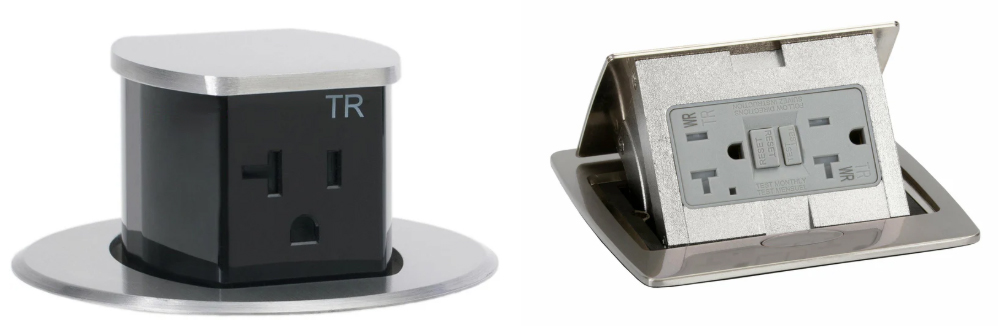
And that’s where we stand with the 2026 edition of the NEC. No receptacle is required at a kitchen island, but if it’s installed then it must be on, in, or above the countertop. If no receptacle is installed then provisions must be provided for future installation. Also there’s some added language to prohibit putting an outlet on a nearby wall and trying to claim that it serves the island countertop. And they’ve made clear that if you want to put an outlet on the side of the cabinet then the outlet has to be more than 24 inches below the countertop – way down low basically so that it can’t be used by an appliance on the countertop.
Another summary:
- It used to be allowed and very common to put an outlet on the side of the cabinet to serve the kitchen island countertop, but not more than 12 inches below the countertop surface. Only one receptacle was required for an island, unless the island was very small.
- In 2020 you needed more than one receptacle if the island countertop space was more than 9 square feet.
- In 2023 and later no receptacle at all was required for a kitchen island. If there was a receptacle it could not be installed on the side of the cabinet. It had to be above or in the countertop surface. If no receptacle was installed then there had to be provisions for a future installation.
Are you wondering why?
Here’s the same kitchen island with the same outlet, and now there’s a coffee maker plugged in. The fear and the risk are that a small child will crawl up and pull on the coffee maker’s power cord, pulling the appliance off the countertop and onto the child.

According to data from the Consumer Product Safety Commission, between 1991 and 2020 an estimated 9,700 people, many of them children, were treated in United States emergency rooms for injuries sustained by pulling on or running into power cords plugged into receptacle outlets installed below countertop work surfaces. Moving the outlets above the countertop surface should help eliminate many of these injuries.
Keep in mind that the rules I’ve described here are for work that was permitted by the local authority having jurisdiction when these particular editions of the National Electrical Code were in force. Your city might not enforce the NEC, and if it does then it might be one or more code cycles behind (e.g. still enforcing the 2017 edition in 2025). Which code – and which edition of that code – applies to the work in your kitchen depends on your local city’s code enforcement.
Stay safe out there.
More Posts You May Find Interesting
Kitchen island receptacle outlets
The rules for receptacle outlets at kitchen islands have changed quite a bit over the last few code cycles. Here’s a summary of these rule changes. Our story begins way back in the last century
I Recommend that you read this
I’ve read a lot of inspection reports over the years from other inspectors, and mostly they’re terrible. Not necessarily the technical content (although that can be pretty bad too), but in the way they’re written.
Is this to code?
A home inspection isn’t supposed to be a code inspection, but a very common question from buyers after I’ve pointed out a problem is something like, “Is this a code violation?” I’m happy to talk
Occupancy Classifications
Occupancy classification is the formal designation of the primary purpose of the building, structure or portion thereof. These are the occupancy classifications as taken from the International Fire Code 2024. Many of these occupancies have
Fire Extinguishers
According to the International Fire Code and the National Fire Protection Association Fire Code (NFPA 1) portable fire extinguishers are required in new and existing buildings with these occupancy types: A, B, E, F, H,
Wire colors
The color for wire insulation is clearly described in the National Electrical Code and is an important part of the electrical installation. The colors of the wire insulation help to identify the purpose and usage
