
Maintaining a proper humidity level in your house is important for many reasons, ranging from comfort to health to preventing damage to your house. If you’re in a heating climate, like the Chicagoland area, you should aim for a relative humidity of about 35-40%. Here’s why.
According to the American Society of Heating, Refrigerating, and Air Conditioning Engineers (ASHRAE) most people will be comfortable with a relative humidity between 25% and 60%. So for comfort, that’s about the range you should be looking for. Relative humidity that’s too low leads to drying of skin and mucous membranes of the nose and throat. Relative humidity that’s too high leads to a clammy, muggy feeling and a loss of necessary evaporative cooling from the body.
But wait – there’s more.
A relative humidity of 60% is quite high and will likely lead to problems with condensation on cold surfaces. Condensation on windows is annoying, and that water can cause stains or even damage to windows. Condensation in other cold places can lead to mold growth, which is a health problem. So 60% relative humidity is far too high.
In a famous academic paper published in 1985, the authors Sterling, Arundel, and Sterling reviewed existing literature and laid out the effects of relative humidity on various airborne contaminants that can inhabit our homes and offices. In some cases, as with viruses, both too little and too much relative humidity can lead to increases in the proliferation of these contaminants. In other cases, either too much or too little is bad.
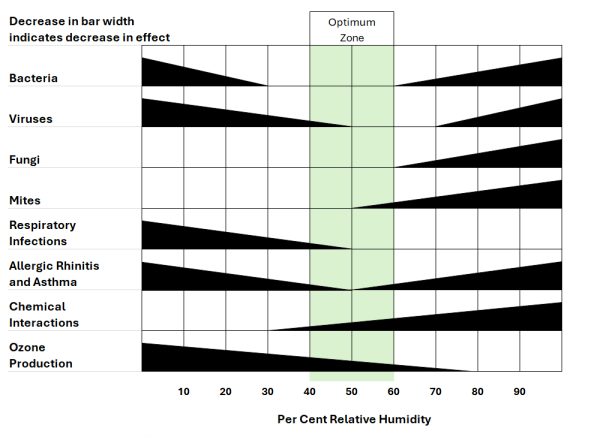
I’ve recreated the chart that Sterling et al included in their paper, and as you can see they defined an optimum zone of between 40 and 60 per cent relative humidity. This reduces the growth and proliferation of these contaminants, while staying within the zone that most people feel comfortable in. And remember that at the high end of this range you’re likely to get condensation on cold surfaces that can lead to mold, so you’re better off staying on the low end of the scale, maybe even a little below it. Around 35-40 per cent relative humidity should work best in most heating climates like Chicagoland.
To measure relative humidity you can get a hygrometer. But keep in mind that measuring relative humidity isn’t all that easy, and a cheap hygrometer might have an error range that makes it all but useless. Just because it shows relative humidity with a fancy digital display doesn’t mean that it’s accurate.
More Posts You May Find Interesting
Kitchen island receptacle outlets
The rules for receptacle outlets at kitchen islands have changed quite a bit over the last few code cycles. Here’s a summary of these rule changes. Our story begins way back in the last century
I Recommend that you read this
I’ve read a lot of inspection reports over the years from other inspectors, and mostly they’re terrible. Not necessarily the technical content (although that can be pretty bad too), but in the way they’re written.
Is this to code?
A home inspection isn’t supposed to be a code inspection, but a very common question from buyers after I’ve pointed out a problem is something like, “Is this a code violation?” I’m happy to talk
Occupancy Classifications
Occupancy classification is the formal designation of the primary purpose of the building, structure or portion thereof. These are the occupancy classifications as taken from the International Fire Code 2024. Many of these occupancies have
Fire Extinguishers
According to the International Fire Code and the National Fire Protection Association Fire Code (NFPA 1) portable fire extinguishers are required in new and existing buildings with these occupancy types: A, B, E, F, H,
Wire colors
The color for wire insulation is clearly described in the National Electrical Code and is an important part of the electrical installation. The colors of the wire insulation help to identify the purpose and usage
