
Here’s a quick schematic diagram of a central air conditioner system. There’s the outside unit, known as the condensing unit. There’s everything inside the house, consisting mostly of the evaporator coil, a metering device, and of course the blower fan that blows the cold air through the ducts and into the rooms.
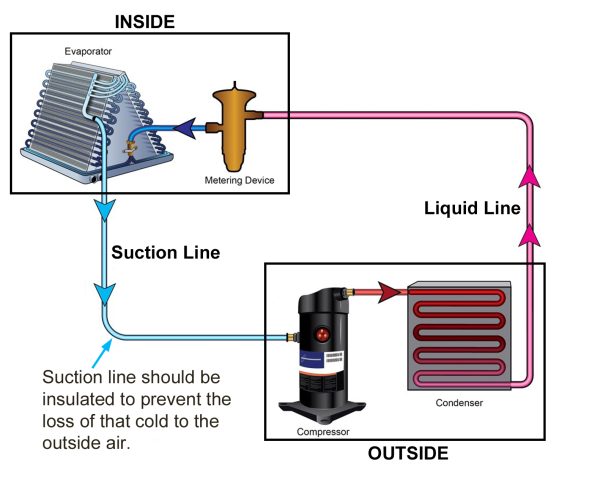
And of course there are two refrigerant lines running between these two parts.
As shown in the diagram by the red color, the liquid line is warm because it’s just been compressed. When a gas is compressed it becomes hotter. Then the fan at the condensing unit outside blows over the condenser and tries to blow that heat out into the open air. But the liquid line is still warm. We don’t want to or need to insulate this line because we want that heat to be lost to the atmosphere.
The suction line is cold, because that refrigerant has just gone through the evaporator coil and expanded, making it cold. When a gas expands it cools down. We want to insulate this line because we don’t want to lose that cold temperature. We’ve just paid a lot of money to make that line cold and we don’t want to lose that. So we insulate this suction line. Over time that insulation will degrade and start to fall off, and if this happens it should be replaced. Missing insulation means that we’ll lose that cold to the outside air and that’s a waste – it robs the system of efficiency.
The insulation inside the house should also be insulated, partly for efficiency but largely to stop condensation from forming on the cold pipe and dripping down and causing damage.
More Posts You May Find Interesting
Kitchen island receptacle outlets
The rules for receptacle outlets at kitchen islands have changed quite a bit over the last few code cycles. Here’s a summary of these rule changes. Our story begins way back in the last century
I Recommend that you read this
I’ve read a lot of inspection reports over the years from other inspectors, and mostly they’re terrible. Not necessarily the technical content (although that can be pretty bad too), but in the way they’re written.
Is this to code?
A home inspection isn’t supposed to be a code inspection, but a very common question from buyers after I’ve pointed out a problem is something like, “Is this a code violation?” I’m happy to talk
Occupancy Classifications
Occupancy classification is the formal designation of the primary purpose of the building, structure or portion thereof. These are the occupancy classifications as taken from the International Fire Code 2024. Many of these occupancies have
Fire Extinguishers
According to the International Fire Code and the National Fire Protection Association Fire Code (NFPA 1) portable fire extinguishers are required in new and existing buildings with these occupancy types: A, B, E, F, H,
Wire colors
The color for wire insulation is clearly described in the National Electrical Code and is an important part of the electrical installation. The colors of the wire insulation help to identify the purpose and usage
