
Water is your home’s number one enemy. I’ve said that before, I’m saying it now, and I’ll say it again.
Water in your attic can cause problems including mold growth, deterioration of the roof’s plywood sheathing, deterioration of the roof rafters, and damage to insulation that can reduce its effectiveness, and potentially ugly stains on the ceiling below.
There are several possible sources of water in your attic, including a leaky roof. But the source of water that I want to discuss here is water from condensation – moisture in the air that condenses on cold surfaces. So let’s talk about condensation.
Condensation occurs whenever the amount of moisture in the air and the temperature of that air reach a critical point – whenever the air temperature falls below the dew point of the air. So condensation is a function of the amount of moisture in the air (the air’s absolute humidity) and the air temperature. As the air temperature drops the relative humidity increases until it reaches 100 percent, at which point the air can’t hold any more moisture and liquid water condenses. You see this in everyday life as dew on the grass in the early morning and as condensation on a cold can of soda pop on a warm summer day.
Condensation happens first at the coldest surfaces, since that’s the first place where the temperature gets cold enough to cause condensation. Here’s an example.

This picture shows three glasses of water. On the left is room temperature water, in the middle is cool water with a couple of ice cubes, and on the right is very cold water with lots of ice. And it’s only this glass with very cold water that has any condensation on it. The coldest glass is where condensation happens first.
Now let’s think about your attic. Where will condensation happen first in your attic: at the coldest place of course. And where’s the coldest place in your attic? We know that warm air rises, so it makes sense that the coldest part of the attic is going to be down at the bottom. We also know that because we’re in the Northern Hemisphere (at least I am) that the sun’s rays will hit the north side of the roof at a more shallow angle than the south side, if the sun hits the north side at all. So the north side of the roof is going to be colder since it gets less sunshine.
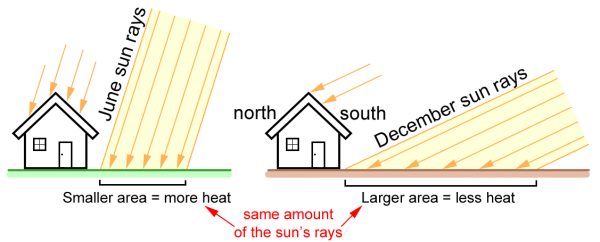
So that makes the coldest part of the attic the bottom of the north side. And so if condensation is going to happen in your attic because there’s too much moisture then the bottom of the north side is where condensation will occur first. It’s pretty common that I can go up into an attic and tell which side is north just by looking for dark stains at the bottom of the roof sheathing. The water that’s condensed on the underside of the roof surface causes staining, possibly mold, and possibly other problems. So the bottom of the north side of the roof is usually the canary-in-a-coal-mine of attic moisture problems – that’s where the problem will start and so that’s the area to look at first and to keep track of.
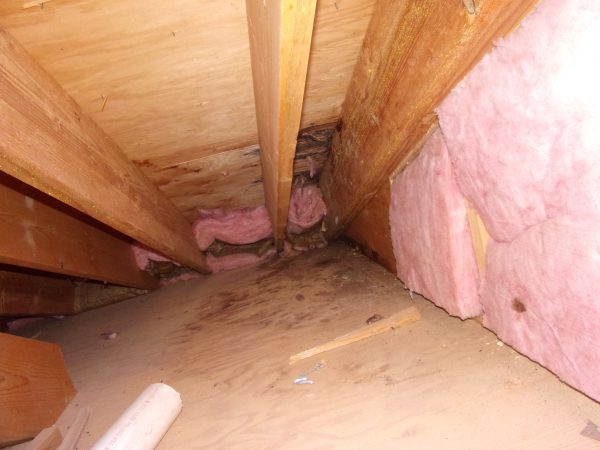
This must be the north side of the house.
As with pretty much any moisture problem in the attic (that’s not caused by a roof leak) the solution is twofold: prevent moisture from getting into the attic in the first place, and using proper ventilation to remove any moisture that finds its way up there.
More Posts You May Find Interesting
Kitchen island receptacle outlets
The rules for receptacle outlets at kitchen islands have changed quite a bit over the last few code cycles. Here’s a summary of these rule changes. Our story begins way back in the last century
I Recommend that you read this
I’ve read a lot of inspection reports over the years from other inspectors, and mostly they’re terrible. Not necessarily the technical content (although that can be pretty bad too), but in the way they’re written.
Is this to code?
A home inspection isn’t supposed to be a code inspection, but a very common question from buyers after I’ve pointed out a problem is something like, “Is this a code violation?” I’m happy to talk
Occupancy Classifications
Occupancy classification is the formal designation of the primary purpose of the building, structure or portion thereof. These are the occupancy classifications as taken from the International Fire Code 2024. Many of these occupancies have
Fire Extinguishers
According to the International Fire Code and the National Fire Protection Association Fire Code (NFPA 1) portable fire extinguishers are required in new and existing buildings with these occupancy types: A, B, E, F, H,
Wire colors
The color for wire insulation is clearly described in the National Electrical Code and is an important part of the electrical installation. The colors of the wire insulation help to identify the purpose and usage
