
A fairly common deck-building problem I see is when a beam is attached to the side of a post with only bolts as attachment. It looks something like this. Usually the two individual pieces of 2x lumber are attached on opposite sides of the post, with two bolts through the entire assembly. Then the individual floor joists sit on top of this beam.
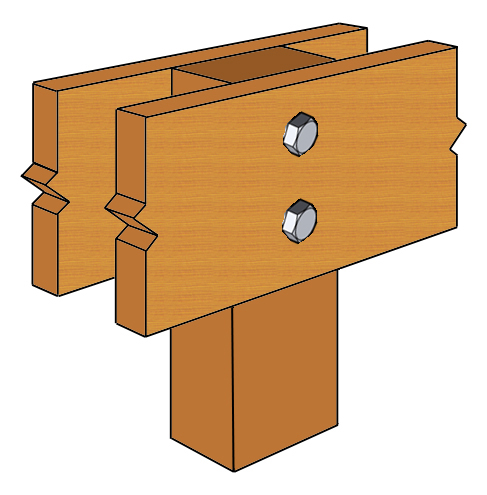
This used to be a very typical way to build a deck, and the truth is that it works very well. It’s easy to build this way, because you can just leave the post long, clamp these beams to the post, adjust them slightly to get them at exactly the right height, and then drill holes for the bolts. After the beam is secured you just come by and cut off the excess height of the post. And as far as I can tell no deck has ever failed from a connection like this. But alas, even though it works it isn’t right.
The International Residential Code says (section 507.5.1) that the ends of a deck beam (any beam, really) must have at least 1.5 inches of bearing on a wood or metal post (that’s in the long direction of the beam) and at least 3 inches of bearing on a concrete or masonry post. But the bolt is at most only 0.5 inch diameter, so the beam doesn’t have enough bearing surface to sit on.
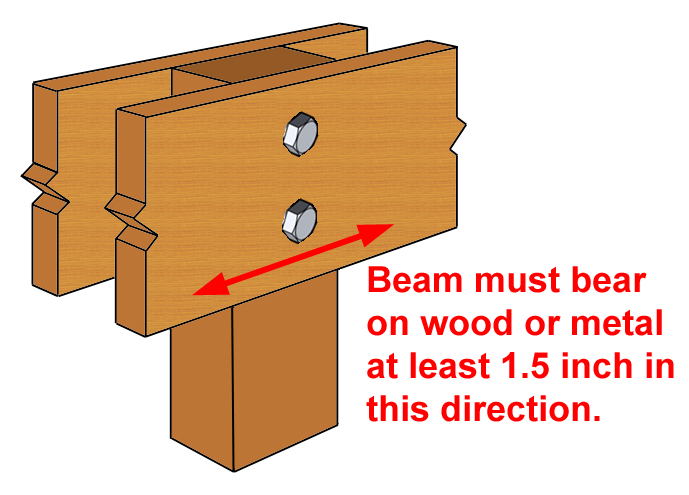
The proper way to attach a beam is to cut the post to the correct height and set the beam on the top of the post. This can be done with hardware that’s readily available at any large hardware store. Or there is bracket hardware available that allows you to attach the beam to the side of the post but provides a proper bearing surface. Something like this:
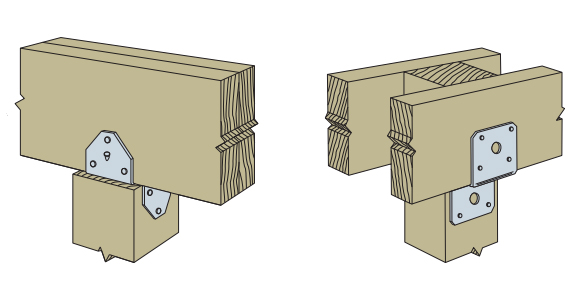
As you can see, there’s the minimum of 1.5 inches of bearing on this metal bracket, so it satisfies the requirements of the International Residential Code.
Of course the question comes up – should I fix this? I don’t think it’s worth fixing a problem like this. It’s not going to fail – at least, this kind of connection has never failed in the entire history of decks, as far as I can tell. But when you go to sell, the next buyer might have a problem with it. You can get the bracket hardware to add to a proper connection, and that’s likely to satisfy most buyers.
More Posts You May Find Interesting
Kitchen island receptacle outlets
The rules for receptacle outlets at kitchen islands have changed quite a bit over the last few code cycles. Here’s a summary of these rule changes. Our story begins way back in the last century
I Recommend that you read this
I’ve read a lot of inspection reports over the years from other inspectors, and mostly they’re terrible. Not necessarily the technical content (although that can be pretty bad too), but in the way they’re written.
Is this to code?
A home inspection isn’t supposed to be a code inspection, but a very common question from buyers after I’ve pointed out a problem is something like, “Is this a code violation?” I’m happy to talk
Occupancy Classifications
Occupancy classification is the formal designation of the primary purpose of the building, structure or portion thereof. These are the occupancy classifications as taken from the International Fire Code 2024. Many of these occupancies have
Fire Extinguishers
According to the International Fire Code and the National Fire Protection Association Fire Code (NFPA 1) portable fire extinguishers are required in new and existing buildings with these occupancy types: A, B, E, F, H,
Wire colors
The color for wire insulation is clearly described in the National Electrical Code and is an important part of the electrical installation. The colors of the wire insulation help to identify the purpose and usage
