
Some appliances have a two-prong plug and some use a grounding three-prong plug.
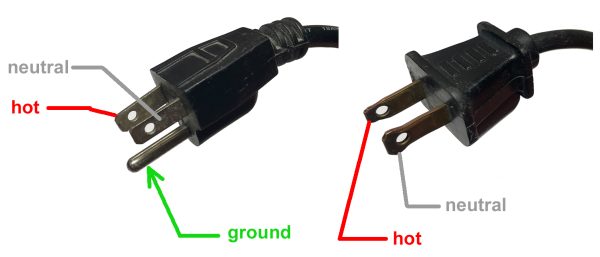
An appliance with a grounding three-prong plug needs to be plugged into a receptacle outlet that has a grounding connection. Here is a quick discussion of equipment grounding and a common problem called an open ground receptacle outlet.
Here’s a schematic of a simple electrical circuit for a washing machine. We attach a hot wire (shown in red) to a circuit breaker, we attach a neutral wire (shown in gray) to the neutral bus bar, and those two wires run to the appliance and through the electrical load (the pump, the motor, the controller).
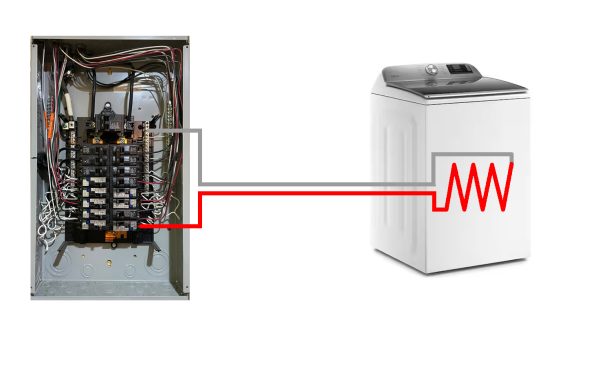
This is the way all appliances were wired for a very long time. But eventually we realized that we could make them safer by adding an equipment grounding wire.
Suppose that the insulation on the wire rubs off and the wire and makes contact with the outer metal case of an appliance. If you touch this outer metal case then you can be shocked. It’s quite unsafe.
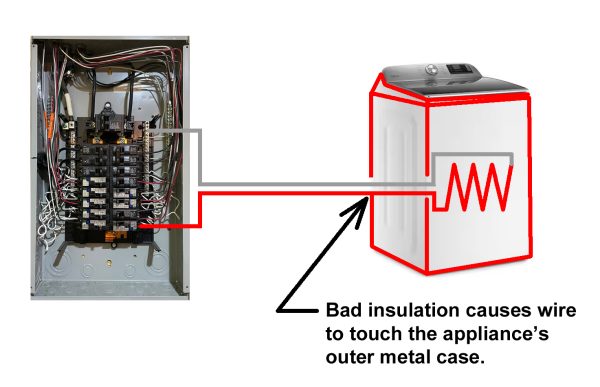
And so we added an equipment grounding conductor, which is attached to the metal case of the appliance and runs back to the neutral bus bar of the electrical panel. It looks like this.
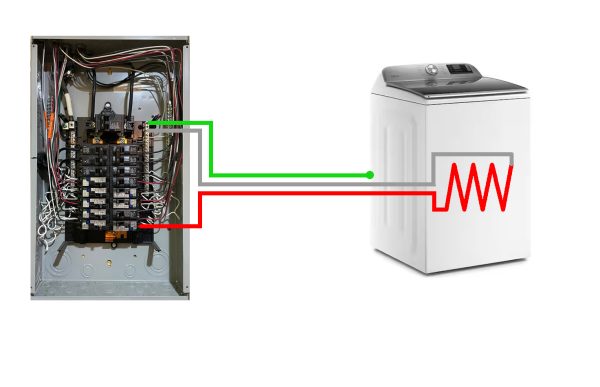
Now if the wire insulation rubs off and the wire makes contact with the metal case then a complete circuit has been made. Current flows in through the hot wire, contacts the metal case and flows over it to the ground wire, and then runs back to the neutral bus bar in the electrical panel. And this circuit has very little resistance. The current isn’t flowing through the appliance’s load – it’s only flowing through the wire and the metal case. It looks like this:

The equation that describes electrical flow is: V = IR
Voltage equals current times resistance. We know that the voltage is constant at either 120 volts or 240 volts. So if the resistance is very low then the current will be very high – high enough to trip off the circuit breaker. And once the circuit breaker trips off then there’s no power to the appliance and everyone is safe. That’s what we want. That’s what equipment grounding does to keep us safe – it creates an electrical path with very little resistance that causes the circuit breaker to trip off. And it happens automatically, very very quickly, and without regard to whether the appliance is on or off.
Some appliances need to be grounded, while many don’t. In general, an appliance with a metal outer case needs to be grounded, but there are exceptions. The important thing to keep in mind is that if the appliance’s plug is a grounding type three-prong plug then it needs to be plugged into a receptacle outlet that provides that ground wire connection.
Some outlets, for a variety of possible reasons, don’t have that ground wire connection even though they look like they should. This is called an open ground receptacle outlet. Using these outlets with a grounded appliance isn’t safe, because you don’t get the safety benefit that equipment grounding provides.
It’s important to keep in mind that appliances will work just fine without an equipment grounding connection (except that surge protectors won’t work without a ground connection). It’s only if something goes wrong that you might realize that you don’t have the kind of safety that you should. So you won’t know that the grounding protection is missing and you might think that everything is just fine, until it’s too late. The only way to know is to use an electrical tester to determine if the equipment grounding wire is connected properly.
And of course the question comes up: How hard is it to fix this problem? The answer of course is: It depends. Until an electrician investigates you can’t know for sure. Usually this is a pretty easy fix, but not always. One of several possible solutions is to replace the outlet with a GFCI receptacle outlet. In this case you need to put a sticker on the outlet saying “no equipment ground”. This is a fine solution, but remember that a surge protector won’t work if there’s no ground wire present.
We call this equipment grounding, but you’ll notice that the “ground”, the earth, the dirt beneath our feet isn’t part of this process. You can’t fix the problem of an open ground receptacle by running a wire outside connected to some rod buried in the ground. That wouldn’t work and the National Electrical Code forbids it.
More Posts You May Find Interesting
Kitchen island receptacle outlets
The rules for receptacle outlets at kitchen islands have changed quite a bit over the last few code cycles. Here’s a summary of these rule changes. Our story begins way back in the last century
I Recommend that you read this
I’ve read a lot of inspection reports over the years from other inspectors, and mostly they’re terrible. Not necessarily the technical content (although that can be pretty bad too), but in the way they’re written.
Is this to code?
A home inspection isn’t supposed to be a code inspection, but a very common question from buyers after I’ve pointed out a problem is something like, “Is this a code violation?” I’m happy to talk
Occupancy Classifications
Occupancy classification is the formal designation of the primary purpose of the building, structure or portion thereof. These are the occupancy classifications as taken from the International Fire Code 2024. Many of these occupancies have
Fire Extinguishers
According to the International Fire Code and the National Fire Protection Association Fire Code (NFPA 1) portable fire extinguishers are required in new and existing buildings with these occupancy types: A, B, E, F, H,
Wire colors
The color for wire insulation is clearly described in the National Electrical Code and is an important part of the electrical installation. The colors of the wire insulation help to identify the purpose and usage
