
Here’s a short quiz on energy efficiency priorities.
Suppose you have two cars, and both get driven about the same number of miles. One car is kind of old and only gets 20 miles per gallon. The other car is new and very efficient and it gets 40 miles per gallon.
You just got a bonus from work and have enough money to do a tune-up and improve the gas mileage of just one of these cars. Your mechanic says that he can improve the efficiency of the older car from 20 to 25 miles per gallon, an improvement of just 5 miles per gallon. Or he can improve the efficiency of the newer car from 40 to 50 miles per gallon, a tremendous bump of 10 miles per gallon. Which one should you choose? Remember, both cars are driven the same number of miles.
Shouldn’t you choose to boost the gas mileage of the newer car by 10 miles per gallon? Isn’t a boost of 10 miles per gallon better than a boost of only 5 miles per gallon?
No. You should improve the gas mileage of the older car from 20 to 25 miles per gallon.
Here’s the math to show why.
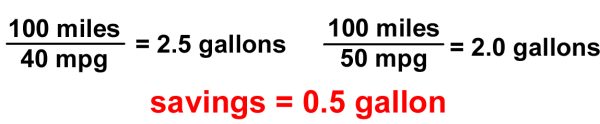
Let’s say that you’ll drive 100 miles. For the newer car, at 40 mpg you’ll use 100/40 = 2.5 gallons of gas. At 50 mpg you’ll use 100/50 = 2.0 gallons of gas, so you’ve saved 0.5 gallon of gas.
For the older car, at 20 mpg you’ll use 100/20 = 5 gallons of gas. At 25 mpg you’ll use 100/25 = 4 gallons of gas, so you’ve saved 1.0 gallon of gas.
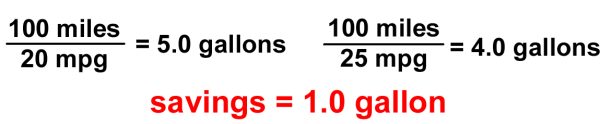
So you’ll save more gas by making a smaller improvement to the car with the worse gas mileage. This might be counterintuitive, but it’s a simple concept: take what’s bad and make it good before taking what’s good and making it great. That’s almost always your best move.
In terms of the energy efficiency of your house, think about it this way: Don’t add more insulation to the attic if there’s none at all in the walls. Insulate the walls first. Focus on the biggest problems and improve them before tackling the smaller problems.
More Posts You May Find Interesting
Kitchen island receptacle outlets
The rules for receptacle outlets at kitchen islands have changed quite a bit over the last few code cycles. Here’s a summary of these rule changes. Our story begins way back in the last century
I Recommend that you read this
I’ve read a lot of inspection reports over the years from other inspectors, and mostly they’re terrible. Not necessarily the technical content (although that can be pretty bad too), but in the way they’re written.
Is this to code?
A home inspection isn’t supposed to be a code inspection, but a very common question from buyers after I’ve pointed out a problem is something like, “Is this a code violation?” I’m happy to talk
Occupancy Classifications
Occupancy classification is the formal designation of the primary purpose of the building, structure or portion thereof. These are the occupancy classifications as taken from the International Fire Code 2024. Many of these occupancies have
Fire Extinguishers
According to the International Fire Code and the National Fire Protection Association Fire Code (NFPA 1) portable fire extinguishers are required in new and existing buildings with these occupancy types: A, B, E, F, H,
Wire colors
The color for wire insulation is clearly described in the National Electrical Code and is an important part of the electrical installation. The colors of the wire insulation help to identify the purpose and usage
