
Let’s talk about wood shrinkage.
Your hardwood floors are the place where you’re mostly likely to see the problems associated with wood shrinkage, but old panel doors can also experience problems. In floors, as the individual boards shrink, gaps open up between them. These gaps are unsightly and a big source of frustration for some homeowners.
Wood naturally contains water, and the point when its water content is stable is called the equilibrium moisture content (EMC). At this point the water content in the wood is stable and in equilibrium, so the wood isn’t gaining or losing moisture to its environment. This equilibrium moisture content depends mostly on the relative humidity of the air and it depends a little bit on the air temperature. It also depends a little bit on the species of wood. For example, at 70 °F and 40 % relative humidity typical wood will have an EMC of 7.7 – which means that 7.7 per cent of the wood’s weight is water. Keeping the relative humidity fixed at 40 %, the EMC will vary from 7.9 at 30 °F to 7.2 at 100 °F. That’s not much change.
But keeping the temperature fixed at 70 °F , the EMC will vary from 5.4 at 25 % relative humidity to 11.0 at 60 %. That’s a big change. (The values of 25 % and 60 % relative humidity are the minimum and maximum values considered comfortable to most people according to the American Society of Heating, Refrigeration, and Air Conditioning Engineers – ASHRAE).
Here’s a chart showing the EMC for typical wood species based on air temperature and relative humidity.

Great, but what does this mean for shrinkage? We can calculate the growth and shrinkage of wood based on its EMC using any of the several calculators that you can find online. They’re based on empirical data and take into account the species of wood and the direction of the grain.
Here’s a cross section of a typical tree, showing the growth rings. When wood grows or shrinks with changes in moisture content, the growth rings want to get a little fatter or thinner, but they also want to get bigger or smaller. Like this.
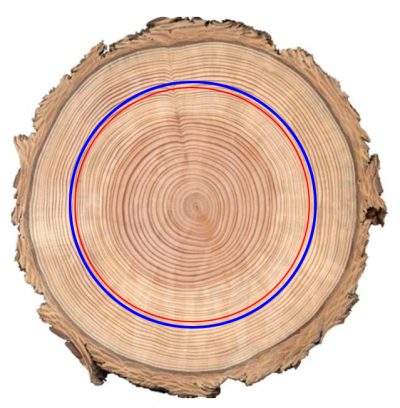
We start with this growth ring highlighted in red. When the moisture content in this wood increases the growth ring wants to get a little fatter and it wants to get bigger, as highlighted in blue (the amount of growth is an exaggeration).
When the log is cut at the mill there are several options. The most common cut is flat sawn, as shown below. You can see how the growth rings then will run in a curved fashion through the width of the board.
Another option is quarter sawn, as shown below. This involves cutting the log into quarters and then cutting each slice in such a way that the growth rings run mostly straight through the thickness of the board. Quarter sawn wood is generally considered to look much better than flat sawn, and it’s much more stable. Quarter sawing is more labor intensive because the log has to be flipped for each successive cut, and there’s more waste involved. So quarter sawn lumber is quite a bit more expensive than flat sawn.

When wood expands and shrinks with moisture it will move more in the tangential direction than in the radial direction. The ratio of tangential movement to radial movement (as you might guess, called the T/R ratio) is about 2 for most species of wood, although it does vary. So if your hardwood floors are flat sawn (as most are) then shrinkage and growth with changes in indoor humidity will be greater than if you had quarter sawn floors.
Tangential movement is greater than radial movement, and flat sawn boards have more of their dimension in the tangential direction. So they’ll move a lot. Radial movement is less, and quarter sawn boards have more of their dimension in the radial direction, so they’ll move only a little. Also, flat sawn boards tend to bend (cup and crown) as they shrink and grow. Boards that aren’t flat are unsightly, and they cause big problems if you’re making furniture.
Yes, but how much movement? As an example, if you have flat sawn oak floors that are a typical 2-1/4 inch wide, an indoor relative humidity change from 60% down to 25% will cause a shrinkage of about 0.04 inch. That’s not bad but it’s noticeable and might be annoying. Hopefully your floor boards were installed when the wood was somewhere in the middle of this humidity range, which would cut that shrinkage gap in half and look a lot better.
For quarter sawn oak boards the shrinkage would be only about 0.02 inch even at the extreme humidity swing from 60% to 25%.
This all helps to underscore just how important it is to have the house tightened up, conditioned to the proper temperature and humidity, and to allow the floor boards to acclimate to these conditions before installing the flooring.
More Posts You May Find Interesting
Kitchen island receptacle outlets
The rules for receptacle outlets at kitchen islands have changed quite a bit over the last few code cycles. Here’s a summary of these rule changes. Our story begins way back in the last century
I Recommend that you read this
I’ve read a lot of inspection reports over the years from other inspectors, and mostly they’re terrible. Not necessarily the technical content (although that can be pretty bad too), but in the way they’re written.
Is this to code?
A home inspection isn’t supposed to be a code inspection, but a very common question from buyers after I’ve pointed out a problem is something like, “Is this a code violation?” I’m happy to talk
Occupancy Classifications
Occupancy classification is the formal designation of the primary purpose of the building, structure or portion thereof. These are the occupancy classifications as taken from the International Fire Code 2024. Many of these occupancies have
Fire Extinguishers
According to the International Fire Code and the National Fire Protection Association Fire Code (NFPA 1) portable fire extinguishers are required in new and existing buildings with these occupancy types: A, B, E, F, H,
Wire colors
The color for wire insulation is clearly described in the National Electrical Code and is an important part of the electrical installation. The colors of the wire insulation help to identify the purpose and usage
